Editor in chief:Dai Rongyang
Deputy Editor-in-Chief:Li Zhi
Governed by:The Education Department of Sichuan Province
Sponsored by:North Sichuan Medical College
Phone:0817-2242637
Email:xuebaocby@126.com
ISSN1005-3697
CN51-1254/R
 NewsDownload Section


I. Ethics
1. Editor Responsibility: Editors should accept or evaluate manuscripts for their intellectual content without bias towards race, gender, religious belief, ethnicity, citizenship, political philosophy or sexual orientation of the authors, and try their best to ensure the quality of articles published on this journal. Editorial staff must not disclose any information about a submitted manuscript to anyone other than the corresponding author, reviewers, and editors. Editors would take reasonable steps to identify and prevent the publication of papers involving academic misconduct. They would not encourage such academic misconduct, or knowingly allow such misconduct to take place. The editorial office would take appropriate action if there were any allegation of research misconduct. Publishers and editors should always be ready to publish corrections, clarifications, retractions, and apologies when needed.
2. Reviewer Responsibility: Reviewers shall treat all manuscripts with a professional attitude to make the review process transparent, confidential and fair. Review comments should address the views and content of the manuscript, not the authors personally. Once the reviewers find that there are mistakes, plagiarism, suspected forgery of data and other problems in the article, they are obliged to report it to the editorial office. Reviewers shall not use unpublished papers or materials in their research. If the reviewers have competition, collaboration, or other relations with the author, company or institution related to the article, they should report the conflict of interest and avoid reviewing the article.
3. Author Responsibilities:
1) Multiple Submission: The journal uses the Academic Misconduct Literature Check system developed by CNKI to test all submitted manuscripts. Multiple submission or redundant publishing is strictly prohibited (including submission of the same content in different languages). If any of the above situations is found, the manuscript will be rejected, and the author’s institution will be notified for serious handling.
2) Authorship: Those who are named as authors should directly participate in the research work, write the manuscript or play an important guiding role (such as a graduate tutor). Other contributors of the paper (e.g., laboratory assistant) may be listed in acknowledgement. “Gift author” is strictly prohibited.
3) Medical Ethics: The ethical issue and informed consent of the study must comply with common principles of medical ethics. When research participants are humans, the author should explain whether the procedures comply with the ethical standards formulated by relevant committee (institutional, regional or national) responsible for human trials. The approval document of the committee should be submitted (the approval number should be included in the article). Consent letter from research participants or their relatives must be obtained, but not submitted to the editorial office. When reporting animal experiments, the study should comply with guidelines published by relevant committee on animal rights, and the approval document should be submitted.
4) Trial Registration: Clinical trials must include the Universal Trial Number (UTN) obtained from one of the Primary Registries in the WHO Registry Network. If applicable, the authors should specify the registering institution and the UTN within the article. The articles reporting randomized controlled trials shall comply with the standard of the CONSORT statement (http://www.consort-statement.org/home).
5) Conflict of Interest: All authors must disclose all potential conflicts of interest, i.e., when the financing/personal status/affiliation of the authors (or the authors' organization/employer) may affect the authors' decision, work or manuscript. When a product is mentioned, the author should also disclose whether there is a conflict of interest against competitive products.
4. Use of Generative Artificial Intelligence: Generative artificial intelligence (GenAI) cannot be used to write entire papers or important parts such as methods, results, and analysis. All scientific contributions and intellectual work must be completed by humans. This journal does not accept GenAI or its teams as authors. If GenAI is used, authors must detail its application in the methods section and are fully responsible for any content generated by GenAI, including violations of publishing ethics or infringement. The editorial office prohibits the use of GenAI in manuscript evaluation, decision-making, or communication with authors. Manuscripts or supplementary materials will not be uploaded to publicly available GenAI platforms during the review process to avoid risks of infringement, privacy breach, and confidentiality breach.
II. Editorial Policy
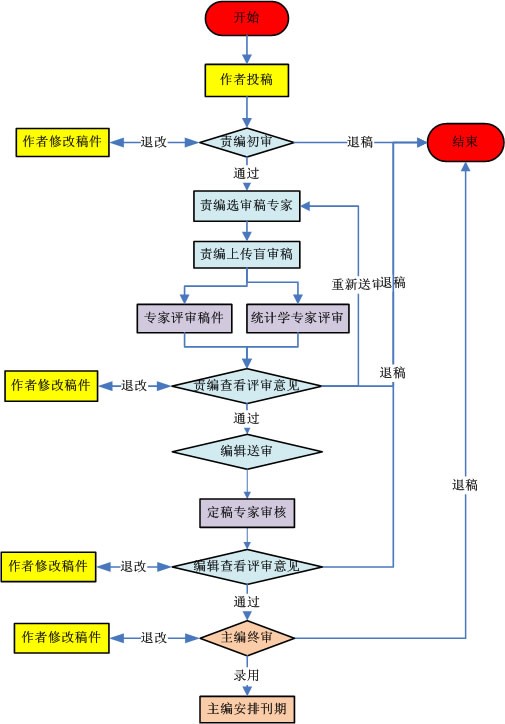
1. Peer Review Process
To ensure academic quality and publishing standards, manuscripts will undergo the following standardized workflow upon submission:
1) Author Submission:? The process is officially initiated upon the author's submission via the journal's online system.
2) Initial Editorial Review:? The assigned editor conducts a preliminary review and makes a judgment: manuscripts failing to meet the journal's basic requirements will be rejected; those meeting fundamental standards will proceed to the peer review stage; manuscripts with deficiencies will be returned for revision? and will re-enter the initial review process upon resubmission.
3) Peer Review:? the editor selects reviewers and uploads the blinded manuscript and initiates the review process. A minimum of two reviewers will conduct an independent double-blind review. Additionally, if the article involves statistical content, it will be subject to a review by statistical experts.
4) Editor Handling:? The editor collects and summarizes review feedbacks: if the review criteria are not met, the manuscript will be rejected; if approved, it will move to the finalization submission? stage; if further improvement is required, it will be returned for revision? and subsequently re-evaluated by the reviewers.
5) Article Finalization:? The manuscript is submitted to the Finalization experts. The editor then reviews the expert's decision: if not approved, the manuscript will be rejected; if approved, it will proceed to the Editor-in-Chief for the final approval.
6) Final Approval:? The Editor-in-Chief conducts the ultimate evaluation to determine whether the manuscript is accepted. Accepted manuscripts will have their publication issue? scheduled by the Editor-in-Chief.
1. Manuscripts submitted by editorial board members and editors must also strictly adhere to the entire review procedures of the journal. The review of these manuscripts will be conducted independently from the editorial board members, editors, and their research teams. Editorial board members and editors must avoid participating in the review of manuscripts authored by individuals with whom they have competition, collaboration, or other conflicts of interest.
2. The review process for supplementary issues, special issues, and special columns follows the same procedure as the regular articles, including identical review and editorial processes, with the Editor-in-Chief making the final acceptance decision. The journal may invite authoritative experts in the field to serve as Guest Editors, responsible for selecting topic, inviting contribution, and taking peer review under the supervision of the Editor-in-Chief to ensure fairness in the review process.
3. Correction and retraction: After publication, if there appears to be an unintended scientific mistake in the article which would not lead to significant impacts on the results and conclusion, the editorial office will publish corrections in the journal as soon as possible, detailing the changes made to the original article. If severe scientific errors are found in published articles, or the article is suspected of academic misconduct, such as plagiarism and data falsification, the editorial office may issue a statement to inform readers of the risks, initiate an investigation and announce the final result, or even retract the article with a retraction statement if necessary.
III. Copyright and OA
1. Open Access Policy: Journal of North Sichuan Medical College flipped to an open access journal since the 5th issue of 2025, and all articles will be immediately and permanently available to readers for free reading and download upon publication on the website. Articles published in and before the 4th issue of 2025 are not open access works, and the copyright of these articles belongs to the Editorial Office of Journal of North Sichuan Medical College. The editorial office reserves all rights for non-OA articles.
2. User Rights: For all open access articles published by this journal, permitted authors and third-party reuse of the articles is defined by the following user license: Creative Commons Attribution-NonCommercial-NoDerivatives 4.0 (CC BY-NC-ND 4.0). This license allows reusers to copy and redistribute the material in any medium or format. The licensor cannot revoke these freedoms as long as the license terms below are followed: reusers must give appropriate credit, provide a link to the license, and indicate if changes were made. Reusers may do so in any reasonable manner, but not in any way that suggests the licensor endorses the use. Reusers may not use the material for commercial purposes. If reusers remix, transform, or build upon the material, they may not distribute the modified material. The full details of the license are available at https://creativecommons.org/licenses/by-nc-nd/4.0/
3. Copyright Transfer: Upon acceptance of the manuscript, the authors shall sign the Copyright Agreement. From the date of signing, the copyright of the submitted paper (including but not limited to the rights of reproduction, distribution, information network dissemination, broadcasting, performance, translation, compilation, adaptation, etc.) shall be transferred free of charge to the Editorial Office of Journal of North Sichuan Medical College worldwide. The editorial office shall have the right to apply for the registration of the copyright of the work in various media as the applicant.
4. Authors’ Rights: The authors agree to the journal's open access policy and acknowledge that the paper may be reproduced, disseminated, or used by the authors and third parties under the terms of the CC BY-NC-ND 4.0 license. Furthermore, the authors are free to exercise the following rights, provided that the copyright ownership of the Editorial Office of the Journal of North Sichuan Medical College is acknowledged:
1) The authors hold the rights of authorship and reputation.
2) Following the publication of the paper in Journal of North Sichuan Medical College, the authors have the right to reproduce the paper in its entirety or in part, without revision and in its published format, when compiling personal collections or publishing personal works in other formats (including on the author’s personal webpage).
3) The authors have the right to reproduce the paper in its entirety or in part for the purpose of personal study, research, lectures, or teaching.
4) If the paper is a work made for hire, created by the authors in fulfillment of tasks assigned by a legal entity or other organization, such legal entity or organization has the right to reproduce the paper for internal use within the scope of its operations.
5. Archive Policy: In addition to the open access on the official journal website, the full texts of the journal's articles are also stored in CNKI, Wanfang Database, CQVIP, etc. Readers can also access the above-mentioned databases and platforms to obtain the articles published by the journal. Moreover, it is allowed for authors to deposit all versions of their articles in an institutional or other repository of the authors' choice. However, it is necessary to indicate the article was initially published in this journal.
Editor in chief:Dai Rongyang
Deputy Editor-in-Chief:Li Zhi
Governed by:The Education Department of Sichuan Province
Sponsored by:North Sichuan Medical College
Phone:0817-2242637
Email:xuebaocby@126.com
ISSN1005-3697
CN51-1254/R
NewsDownload Section External Links